Other poetry in this issue:
An electronic chapbook from Australian writer, Coral Hull
Poetry from Australia:
Coral Hull
Poetry from Canada:
Diana Fitzgerald Bryden
Joelle Hann
Sonnet L’Abbe
rob mclennan
A.F. Moritz
George Murray
David O’Meara
Richard Outram
John Pass
Ann Shin
John Unrau
Paul Vermeesch
Poetry from Israel:
Rochelle Mass
Poets from the United States:
Erin Belieu
Barbara Bowen
Jan Heller Levi
Suzanne Lummis
Gary Whitehead
James Wren
_________
More translations in our
Spring Issue
Summer Issue
Fall Issue
Winter
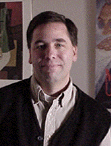 Mark Aldrich teaches Spanish at Dickinson College in Carlisle, PA. He has
published criticism on contemporary Spanish novelists and poets in journals
such as Hispanófila, Anales de la Literatura Española Contemporánea, and
Análisis de Textos Literarios among others. His translations into Spanish of
poems by Charles Simic have appeared in Hora de Poesia and others by Phyllis
Levin are forthcoming in El Laberinto de Zinc. His short story “Puerta Once”
appeared in the literary journal Turia
Mark Aldrich teaches Spanish at Dickinson College in Carlisle, PA. He has
published criticism on contemporary Spanish novelists and poets in journals
such as Hispanófila, Anales de la Literatura Española Contemporánea, and
Análisis de Textos Literarios among others. His translations into Spanish of
poems by Charles Simic have appeared in Hora de Poesia and others by Phyllis
Levin are forthcoming in El Laberinto de Zinc. His short story “Puerta Once”
appeared in the literary journal Turia Robert Archambeau teaches English at Lake Forest College on Chicago’s north shore. His books include Citation Suite (Wild Honey) and Word Play Place (Ohio). He is the editor of the international poetry journal Samizdat and has translated work from French and Swedish.
 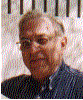 Rafael Pérez Estrada (Málaga, Spain,1934 – 2000) was the author of more than
forty published volumes of prose and poetry. His writing is characterized by
formal and stylistic innovations that challenge traditional notions of genre.
From aphorism to full length novel, Pérez Estrada’s work consistently creates
worlds of astonishing imagination and creativity. His first work, Valle de
los galanes, was published in 1968. His poetry collections Conspiraciones y
conjuras (1986) and El bestiario de Livermoore (1988) were both finalists for
Spain’s Premio Nacional de Literatura. His work has appeared in numerous
anthologies and has been translated into English, French, Swedish, Italian,
and Rumanian. He was also an accomplished painter and illustrator, having had
his work exhibited internationally and published in Insula, ABC, and other
publications. He received his law degree from the University of Granada and
practiced law in his native Málaga. He is translated here by Mark Aldrich.
Rafael Pérez Estrada (Málaga, Spain,1934 – 2000) was the author of more than
forty published volumes of prose and poetry. His writing is characterized by
formal and stylistic innovations that challenge traditional notions of genre.
From aphorism to full length novel, Pérez Estrada’s work consistently creates
worlds of astonishing imagination and creativity. His first work, Valle de
los galanes, was published in 1968. His poetry collections Conspiraciones y
conjuras (1986) and El bestiario de Livermoore (1988) were both finalists for
Spain’s Premio Nacional de Literatura. His work has appeared in numerous
anthologies and has been translated into English, French, Swedish, Italian,
and Rumanian. He was also an accomplished painter and illustrator, having had
his work exhibited internationally and published in Insula, ABC, and other
publications. He received his law degree from the University of Granada and
practiced law in his native Málaga. He is translated here by Mark Aldrich.
Jean-Luc Garneau is a distinguished linguist and the author of Riviere des Morts, a collection of poetry published in his native Quebec. He lives in Chicago.
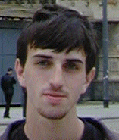 Andrey Kneller, born in Moscow, Russia, was highly influenced by Russian literature and poetry. He began to write poetry when he
was just thirteen years old and since then has written over 350 poems. Fluent in both English and
Russian, Andrey has also translated poetry by Aleksander Pushkin, Boris
Pasternak, Vladimir Vysotsky and other Russian poets. Currently, Andrey is a
senior at St. Raymond High School in the Bronx. In the Fall of 2001, he plans to attend Brandeis University.
Andrey Kneller, born in Moscow, Russia, was highly influenced by Russian literature and poetry. He began to write poetry when he
was just thirteen years old and since then has written over 350 poems. Fluent in both English and
Russian, Andrey has also translated poetry by Aleksander Pushkin, Boris
Pasternak, Vladimir Vysotsky and other Russian poets. Currently, Andrey is a
senior at St. Raymond High School in the Bronx. In the Fall of 2001, he plans to attend Brandeis University.
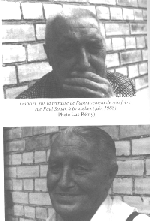 Gabriel and Marcel Piqueray were important figures of surrealist writing in Belgium. Born in 1920, the Piqueray twins wrote separately but always published collectively. In their words, there was only ever “one signature, one station signal, as they say on radio; one overall station signal for the Piquerist state of mind.” Gabriel died in 1991, and Marcel not long after. Their collected works in French, Au-delà des Gestes et Autres Textes are available from Éditions Labor, Brussels.
 Aleksander Pushkin (1799-1837) has often been considered Russia’s greatest poet. His earliest publications were romantic poems and a cycle of romantic narratives which received critical and popular success. He was active in various revolutionary movements in Russia and was banished from St. Petersburg for his political poems in 1820. During his period of exile, his work became more political, marked by elements of Russian folklore and history, and emphasized “ithe judgment of the people” upon the class structure of the time. The failure of the Decembrist revolution and execution of five of its leaders was a grievious experience for Pushkin, though, afterwards, because of his popularity as a poet, the Tsar allowed him to return to Moscow. Upon his return to Moscow, Pushkin continued to write poems and plays and prose pieces, while having his work censored by the Tsar himself and living under police surveillence. After marrying in 1831, he entered government service and received rank at the Tsar’s court primarily because of his wife’s social position. However, he found the situation increasingly difficult. He was regarded with suspicion and his requests to resign and retire to the country were declined. In 1837, he was fatally wounded in a duel defending his wife’s honor, a duel which had been forced by his enemies at the court. Called the “poet of reality,” Pushkin is considered to be the foundation of Russian literature. He has exerted not only a great influence as a poet but as a force for freedom and social change.
