To read the interview with Dana in this issue
To view Dana’s cemetery photos in this issue
Dana’s work online poetryinternational under Israel, beginning May 25.
______
To view Nekoda Singer’s art in this issue
_______
To read Lisa’s interview with Shirley Kaufman also in this issue
Lisa Katz is Contributing Editor for The Drunken Boat
_______
“First Letter to Ona ” is translated, from a Hebrew rendition by the author and others of the original Russian poem,by Lisa Katz and first appeared in Poetry International #4, San Diego State University, October 2000.
“Fourth Letter to Ona” is translated, from a Hebrew rendition by the author and others of the original Russian poem,by Lisa Katz.
“Spell,” is translated from the Hebrew by Lisa Sewell. “Guided Tour of the City of My Birth,”
and “Changes:III ” are translated from the Hebrew by Lisa Katz.
_______
_______
For a report on the Rotterdam translating poetry panel: poetry panel
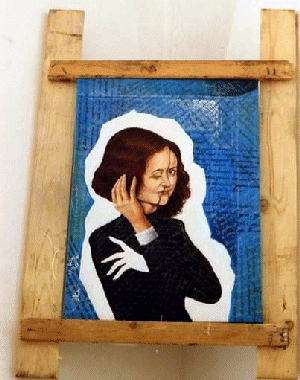
Gali-Dana Singer
First Letter to Ona
You don’t even know what it is: to remember a river,
approach, force yourself to think: River.
What did you see?
A Greek from a creek in a children’s song and many names of bridges,
your hand in perpetual motion
streams like chaos or unconscious fear,
strains to fill the fingers of a glove
while touching the railing.
And you in a puddle of course in a skirt shrunk by time,
you and Petya trapped in embroidery, in satin stitch, in a crooked frame,
like a faded sampler of Lenin with children.
I try to mend as I am told, like an obedient wife,
but the misprints and your endless cold
one way or another will make you sad. So
leave the gloves alone,
stop rubbing them, and I’ll leave
the river, the air and our loves in peace. Don’t touch the air with your hand
and I’ll stop being didactic. Then
force yourself to think: River. Don’t think: Water.
Don’t think of streams of ink or rescue boats
or drinking.
You don’t even know what it is: to remember a river
that’s not an extended scream
that can’t be rolled up like a rug.
You can’t say: look how it twists and turns,
look how duck crumbs spill from trouser pockets
and signals of longing are caught by short waves—
remember the river doesn’t stop, not for granite dust,
for gray hairs, for the petty battle
between lathered cheek and razor,
it’s not read aloud syllable by syllable
like an item about war in the newspaper,
not lined in brocade like a coffin,
not decorated with silver like the soldiers’ uniforms, not eyes
widening, not in magnifying glasses, not in waves
of boulders and flounces, not in voile, not in lace,
which is really silly,
to remember a river that’s not typed in italics, not scattered in
composition.
Give my regards to Boris the turtle if you see him.
In any case you don’t know what it means
to look out of Titus’ city past the hills of Moab,
trying to remember, not the islands of dung piling up by the river,
carrying it toward the bay,
not the olive trees or the weeds, not the two river banks
at the same time, left and right,
not creased, not pleated, —
to remember the river not with a shiny oil spill
around the meatball sailing from the direction of Kirov’s factory.
Approach the river, force yourself to think: River,
when you splash in the puddle without noticing the old man
fishing with the pair of silver arms
from his eyeglasses. Nota bene: Love old men for they are our future,
old women too. A pair of silver arms – that’s all I have left
to remind me of your husband, while trying to remember the river
as I look at the hills of Moab from the city of Titus
and of many others, left and righteous,
and mine, among them for the first time.
An Arab on a donkey passes below and I try
to remember not the donkey’s ass and not the olive trees
but rather the river:
not stopping, not long,
not dependent on words.
The Arab riding the donkey
moves through the scorched valley.
Fourth Letter to Ona
The war years of winter are coming.
—Pushkin the Second
Inesa, my dear, be very wary.
—V.I. Lenin, letter to I. Armand
Don’t call this time war or winter
don’t call this time. Be –I beg you my dear— wary,
beware when choosing definitions in the most patriarchal of all anarchies
a definition is worse than the swallow’s V-sign that doesn’t make a spring.
Don’t mention conscience here, go find a bastard for trial and sue
while mumbling about something connected to dust and ashes
go write this carrion down in a story of temporary summer in our time zone.
The view from the window sealed with dusky nylon reminds me of the moonstones
I struggled so long to remove from grandmother’s ring.
The real model of an ideal place is a house where there are things
to amuse a child.
At grandmother’s they were three:
her alarm clock that clucks to this day
as if adjusting false teeth every six-eighths of a beat
in a race after the sleepy minutes of an afternoon nap;
the conch shell lost while moving from one apartment to another. Father
pulled the shell from the bottom of the Pacific
Ocean because everything was so pacific at grandmother’s
and only the clock clucked.
But even so – all of these things are quiet,
milk with boiled sweets in the shapes of strange animals
as a snack after napping;
and there was a gingerbread house
that slowly disappeared
first the chimney fell and they said it was my fault and wasn’t
heard from again and after that the edges peeled off but I wasn’t beaten
and two hatpins and a pile of buttons remain from the gingerbread house
and the same ring with the opal mentioned above.
Afterwards it fell but did not break, only the steps broke
on which Hansel and Gretel’s grandmother went out to greet the guns
with origami flowers.
Don’t call it war or winter
don’t say: God—
it won’t do any good
in any case be curious and scout the territory from the window
with this sweaty nylon
this territory commanded to lost tribes
to the tribe of Menashe if I remember correctly and someone else who
didn’t return from captivity.
Perhaps it’s not flattering yet without prejudice
you saw the reflection of the moon in the Moab desert and even closer
the reflection of lunar stains
everything is rather flat and clean
like the Procrustean bed after death
whose sheets rustle and grow cold
the liquid
between the glass and the nylon
a stale mixture of rain dust and breaths
brings up between stalactites and stalagmites (and other mute and
anonymous shapes)
what we’d forgotten
the drunken
popular tears of Yelena and Olga
and the cry of insult like a poplar in the flurry and feathers of pogroms.
Vast distances that aren’t subject to the eye
between the war and winter between winter and gas mask
absolutely no man’s knowledge cannot admit no man’s lands
those between the glass and the strips of nylon not to mention the Gaza Strip
and then recalling one distractedly
the water heater and unwashed gauze diapers
hung to dry like flags of surrendering national consciousness.
Don’t call this time.
Spell
I didn’t look good and wasn’t visible
At all
In a net,
Dressed and undressed,
Riding and not riding that ass
With both feet on ground.
Last to arrive, riding backwards, she came
His know-it-all daughter.
Though I didn’t look nice, no one noticed me
At all,
Ashamed and unashamed.
Of my shivering.
In desiccate silence
What she could not see was herself
His delusional daughter.
I couldn’t see well, and didn’t see
At all
Like a last hours’ sentry
The one out of three
Who rises before time, for in me
No spirit rises.
And she was plotting his downfall,
His daughter and twin.
I couldn’t see and goodness I couldn’t see
At all.
Incense of Myrrh,
Dram of bitterness,
Tasting of sand and scented with daylight
She let herself go.
His deceitful daughter.
Since I didn’t look drowned, no one noticed me
At all.
In a ditch
Raising death’s contagion,
Maggots and worms.
Grain’s measure.
Wisdom’s shelter.
A sealed reminder:
His orphaned daughter.
Translated by Lisa Sewell.
Guided Tour to the City of my Birth
IV
When I dwelled in you, my city,
I liked to play with your old names
and a yo-yo.
I left you
before you changed your name
for the fourth time
and what remains of you
is only that name
the most pathetic of all
hated
cold and mute
and another city
which I also call mine.
When I dwelled in you, my city,
I called my love a new name
and when I left you
only that name remained with her
and only that name remained with me
the most foreign
beloved
poor
that anyone may be called.
Changes: III
I tried to think what I had loved knives for, but my mind slipped from the noose of the thought and swung like a bird in the center of empty air.
— Sylvia Plath The Bell Jar
In Sergio’s restaurant I sat near the table made like the others
from a Singer sewing machine with an unexpected ink stain on the top.
The cutlery at Sergio’s
excites me –
they always serve at dinner with different ones.
The scratched spoon of Melchior from my childhood,
a tin fork from a kibbutz, an aluminum fork coated with nickel –
the presents of Caspar and Balthasar,
a silver teaspoon half-eaten by the teeth and years
of Edwardian England – for the mouth of the newborn,
and this time also the knife bearing your family name.
“Mon dieu!”
someone cried when that they brought him grilled mullet –
and then I remembered that in Georgian my name means “knife”
but the idea of metamorphosis still disgusts me
for “the knife of a idolater will be struck into the ground three times and
that’s enough.”
Is this done like this, Dana?
All poems except “Spell” (translated by Lisa Sewell) translated by
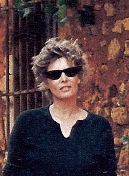 Lisa Katz
