Also in this issue.
Poetry from Australia
______
More poets and translations in:
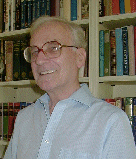 Brian Cole was born in Southampton, England in 1932 and has spent his adult life near London. After studying French and German at Oxford University he followed a career in business as a senior executive in three multi-national groups. After retirement he set up an accountancy practice, which traded until 2000, after which he started Brindin Press (see our feature)— with a website which celebrates poetry in translation — http//www.brindin.com.
In 1994 his first published work was a translation of Pablo Neruda’s The Captain’s Verses, published by Anvil Press in London and reprinted four times. In 2000 Arc Publications in Todmorden, England published Anthracite, a selection of translations from the Italian of Bartolo Cattafi — this collection was awarded the accolade “Recommended Translation” by the Poetry Book Society in London. In August 2001 Brindin Press published his translations of Circe Maia under the title Yesterday a Eucalyptus, which was also chosen Recommended Translation by the Poetry Book Society, and awarded a translation prize by the British Centre for Literary Translation. A selection of his Neruda and Cattafi translations are included in this issue.
Brian Cole was born in Southampton, England in 1932 and has spent his adult life near London. After studying French and German at Oxford University he followed a career in business as a senior executive in three multi-national groups. After retirement he set up an accountancy practice, which traded until 2000, after which he started Brindin Press (see our feature)— with a website which celebrates poetry in translation — http//www.brindin.com.
In 1994 his first published work was a translation of Pablo Neruda’s The Captain’s Verses, published by Anvil Press in London and reprinted four times. In 2000 Arc Publications in Todmorden, England published Anthracite, a selection of translations from the Italian of Bartolo Cattafi — this collection was awarded the accolade “Recommended Translation” by the Poetry Book Society in London. In August 2001 Brindin Press published his translations of Circe Maia under the title Yesterday a Eucalyptus, which was also chosen Recommended Translation by the Poetry Book Society, and awarded a translation prize by the British Centre for Literary Translation. A selection of his Neruda and Cattafi translations are included in this issue.
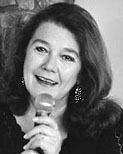 Daniela Gioseffi is an American Book Award winning author of ten
books of poetry and prose from major and alternative presses. Her
first book of poems, Eggs in the Lake (BOA, 1979)won her a New York State
Council for the Arts grant in poetry. Her newest
collection of poems, Symbiosis is an e-book from
Rattapallax Press.
Daniela is editor/publisher of www.PoetsUSA.com which
incorporates Wise Women’s Web and ItalianAmericanWriters.com among
other literary web sites. Her renown anthology, WOMEN ON WAR: International Voices
for the Nuclear Age will be reissued in
new edition by The Feminist Press, NY, 2002. She
also published a novel, and a short story collection, as well as ON PREJUDICE: A Global Perspective (Doubleday, 1993).
Daniela Gioseffi is an American Book Award winning author of ten
books of poetry and prose from major and alternative presses. Her
first book of poems, Eggs in the Lake (BOA, 1979)won her a New York State
Council for the Arts grant in poetry. Her newest
collection of poems, Symbiosis is an e-book from
Rattapallax Press.
Daniela is editor/publisher of www.PoetsUSA.com which
incorporates Wise Women’s Web and ItalianAmericanWriters.com among
other literary web sites. Her renown anthology, WOMEN ON WAR: International Voices
for the Nuclear Age will be reissued in
new edition by The Feminist Press, NY, 2002. She
also published a novel, and a short story collection, as well as ON PREJUDICE: A Global Perspective (Doubleday, 1993).
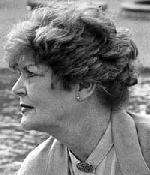 Carilda Oliver Labra was born in 1922 in Matanzas, Cuba. Her debut collection in l943, Lyric Prelude
(Preludio lirico) immediately established her as an important poetic
voice. At the South of My Throat made her famous: the coveted National
Prize for poetry came to her in l950 as a result of the popular and
notorious book, At the South of My Throat (Al sur de mi garganta)
1949. In honor of the tri-centennial of Sor Juana Ines de la Cruz in
a contest sponsored by The Latin American Society in Washington D.C.,
in 1950, she had also received the national Cuban First Prize for her
poems. In
1958, Labra published Feverish memory (Memoria de la fiebre) which
added to her notoriety as a blatantly erotic woman. The book
concerned a theme which has dominated her poetry—that of lost
love—as it was written after the unfortunate and untimely death of
her second husband. Today, in Spain a foundation offers
“The Carilda Oliver Prize for Poetry,” and a documentary of her life
has been produced.
Carilda Oliver Labra was born in 1922 in Matanzas, Cuba. Her debut collection in l943, Lyric Prelude
(Preludio lirico) immediately established her as an important poetic
voice. At the South of My Throat made her famous: the coveted National
Prize for poetry came to her in l950 as a result of the popular and
notorious book, At the South of My Throat (Al sur de mi garganta)
1949. In honor of the tri-centennial of Sor Juana Ines de la Cruz in
a contest sponsored by The Latin American Society in Washington D.C.,
in 1950, she had also received the national Cuban First Prize for her
poems. In
1958, Labra published Feverish memory (Memoria de la fiebre) which
added to her notoriety as a blatantly erotic woman. The book
concerned a theme which has dominated her poetry—that of lost
love—as it was written after the unfortunate and untimely death of
her second husband. Today, in Spain a foundation offers
“The Carilda Oliver Prize for Poetry,” and a documentary of her life
has been produced.
Pablo Neruda was born Ricardo Neftalí Reyes Basoalto in 1904 in southern Chile, the son of an engine-driver; only in 1945 did he legally take the name Pablo Neruda. From this humble beginning he built a colourful life as diplomat, communist, senator, freedom fighter, fugitive — but always a poet. His diplomatic duties took him to India and Indonesia, Mexico, Argentina, Spain and France, and he travelled widely in his private capacity in pursuit of his political and literary interests. Neruda was recalled to Chile in 1938, and then spent three years as Consul-General in Mexico. On his return to Chile in 1943 he formally joined the Communist Party, and was elected to the Senate in 1945. Under the repressive regime of Gonzalez Videla in Chile, the Party was outlawed in 1948 and Neruda was forced to flee into exile first to Argentina, thence to France. Only in 1954 was he allowed to return to his beloved Chile. The last fifteen years of his life — apart from a short spell as Ambassador to France — were spent at Isla Negra (his house on the coast near Valparaiso, opposite an island of that name) with his third wife, Matilde Urrutia. He is a major figure in the world’s literature, as well as dominating twentieth-century South American culture. He was awarded the Nobel Prize for Literature in 1971. He died in 1973, shortly after the murder of his friend President Salvador Allende and the return of repressive government to Chile.
