Poems by Rimas Uzgiris in this issue
_______
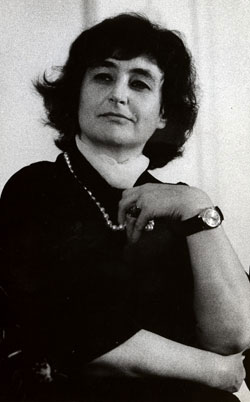
Judita Vaičiūnaitė
Introduction and translations by

Rimas Uzgiris
Judita
Vaičiūnaitė: An
Introduction to Her Work
In
the post-war period, when most poets in Lithuania were writing about politics
(whether communist verse, or veiled resistance poetry), or when they were
focusing their lyricism on nature, on the pastoral (and all its many
significations to a culture still steeped in its pagan past), Judita Vaičiūnaitė, without negating
politics or her bonds with nature, wrote about the life that was immediately in
front of her. She was a poet of the city. Born and raised in Kaunas, then
educated in Vilnius where she remained for the rest of her life, she described
its streets, its crumbling facades, its courtyards and dead ends. She wrote of
city life: going to butcher shops, frequenting cafes, meeting vagabonds and
gypsies, romance in cramped apartments, darkened streets. This thematic
concern with modern city life is
reflected in the style of many of her poems—they are loaded with sharp
and sudden contrasts and juxtapositions. Tender lyricism is cut with violence
and foreboding. The lines often break apart. Parenthesis and elipses appear in
unexpected places. It is as if the world presses in around the central focus of
her poems in ways she cannot control. Randomness, sudden change, and danger are
parts of her city life as much as the beautiful facade, the church bells, the
cobbled streets.
Vaičiūnaitė’s poetical perspective
stood out at the time for another reason as well. She was a poet of the modern
woman: single, educated, working, free… Her poems treat love and courtship
from that woman’s perspective, giving us an interior, lyrical experience where
the man is the distant and desired other. Besides writing the romantic side of
feminism, her poems also express themes like the struggle with restraints of a
patriarchal world, and the conflicts between the freedom and power to seek her
own career path and the responsibilities of motherhood. "The Red
Dress" stands out as an example of the understated, yet powerful way she
treats feminine desire, the restraints imposed upon it, and the expectation of
the modern woman that she will still be free, despite the challenges. Like in
many of her poems, the emotional content is expressed through the symbolic
power of a physical object. In this case, a red dress is pinned on a
clothesline, buffetted by the wind, “yet still”, she writes, “it
will break free”.
Despite her comitment to a modern and cosmopolitan
lifestyle Vaičiūnaitė
did not disconnect herself from
her country’s past. The pagan connection to nature, so prevalent throughout the
history of Lithuanian literature, is in her work as well—but transformed.
Instead of paens to forest and farm, we find flowers growing out of cracks on
the sidewalks, trees dropping their petals over garbage heaps, and run-down
buildings overcome with a rich luxuriance of weeds.
The human history of Lithuania is present in her
work as well. Vaičiūnaitė
excelled at writing lyrical poems from the perspectives of historical and
mythological figures. Only Constantine Cavafy comes to mind as her poetic equal
in the ability to bring us inside a historical personae’s mind in a singular,
sharply defined, deeply felt lyrical moment. Unlike the case of Cavafy,
however, Vaičiūnaitė
personages are mostly woman. As such, she uses them to bring to the fore
perpectives often left out of history. For instance, how did Catherine feel, as
the third wife of king Sigismund Augustus, sister to his first wife, and
neglected by a husband still mourning the death of his second wife and greatest
love? The cycle “Canon for Barbora Ravilaitė• gives us many of
the voices connected to this historical drama in the court of the United
Kingdom of Poland and Lithuania. We hear from the king’s mother, Bona Sforza,
whom many think poisoned the beautiful bride because she was not politically
connected enough to be queen, and
we hear the king himself at Barbora’s deathbed, speaking to us an interior
monologue, drenched in grief and desperate hope. Finally, at the end, we hear
from Barbora herself, travelling in her coffin, hearing the sobs of her
husband, the ticking of hoofs, returned again to be buried in her beloved
Vilnius… and to live on in its dreams. In many of these historical poems, the
fragmentary lines and jagged juxtapositions of the city poet give way to
rhyming, metrical lyricism.
The diversity of styles, personaes and themes in
the work of Judita Vaičiūnaitė,
handled with utmost craft, perception and intelligence, leaves no doubt that we
are in the presence of a major twentieth century poet who deserves a wider
audience beyond the rather small group of Lithuanian readers who have cherished
her for decades.
The Red Dress
A red dress throbs on a rope
like a torch left behind.
Moaning, clawing pines
assault the hotel window.
Someone washed the dress at dawn.
Someone wrung it out.
Endless,
the radiance. The weather—
mindlessly sunny, humid, sharp.
A red dress throbs on a rope—
yet still, it will break free.
Translation
of “Raudona suknelė” by Judita Vaičiūnaitė,
Kristalas: Poezijos Rinktinė.
Lietuvos Rašytojų Sajungos Leidykla: Vilnius (2010)
Pool Hall
The green flatlands crack and split.
Go. Slice the quiet pool-hall
with the solitary steps of a child
(in the gathering shadows of men),
through the grass of horse-tracks, pitches and pastures
(the shadows are now six),
through the flattened field of airplanes—
shadowy, luxuriant, wet—
into the deepening dark (it will soon explode)
hurry (let no one block out
the light in your eyes)…
But greenery is more bitter each day
in the world full of shadows and heat
(a distant white crash—
the sun rolls over an empty green plain
to meet with catastrophe…).
Translation
of “Biliardinė” by Judita Vaičiūnaitė ,
Kristalas: Poezijos Rinktinė.
Lietuvos Rašytojų Sajungos Leidykla: Vilnius (2010)
Vagabond Sun
Despite her light hair, you know
she is gypsy.
Through the hum of the faucet, in the cemented night,
a saxophone heats up the dark (don’t come here
to berate the street urchins, the heat, or the begging dog).
And the skirt,
flowered like a field (how perfectly lacking taste!),
stuns the proper world. It is, after all, borrowed
from taverns, train stations, and fairs…
It’s not clear what is missing,
but words will spread
like the heart’s faded playing cards,
and we should open our veins in the dusty market-place
(the blood gushes as suddenly
as summer rain),
until again, in humid chambers,
alarm clocks begin to sing,
and you will see that the dawn is boundless,
the sun—a vagabond.
Translation of “Klajoklė Saulė” by Judita Vaičiūnaitė
Kristalas: Poezijos Rinktinė. Lietuvos Rašytojų Sajungos Leidykla: Vilnius (2010)
Blossoming Pear
But an old armchair in the corner by the doors,
washed now by such muddy rain,
but the rooms full of mist and smoke,
having drunk in the pale, sleepy sun,
but your time is melted into mine,
a happy, sad time, while the pear tree, blooming,
looks pitifully thin in the mirror,
unreal as lace…
Probably
the blossoms will fall, but I will love you,
and blank walls will shine like mother-of-pearl…
Only the smell of blood, hanging over butcher shops,
only the flash of
a knife, only violence.
Translation
of “Kriaušė Žydi” by Judita
Vaičiūnaitė,
Kristalas: Poezijos Rinktinė.
Lietuvos Rašytojų Sajungos Leidykla: Vilnius (2010)
from Canon for Barbora Radvilaitė
5. Catherine of the Habsburgs
Because of you—I was left faceless.
My features are smoke.
I lie in the very hearth of history, turned to ashes.
Sigismund mourned you, pushing me aside,
disgusted to the point of pain…
But let us not disseminate harms.
I was small when my sister married Sigismund.
I laughed through the engagement, biting a hard apple.
I saw how our crazy grandmother gave the sign of the cross
every morning to the ladies-in-waiting.
I pressed on,
yet it was not my sister’s soul that stood between us—but you.
Like a sword in bed—
Barbora’s name separated us.
I returned to my homeland. After questioning,
they laughed at me.
I remain quiet as a rusted bell.
Translation
of “Kotryna iš Habsburgų” by Judita
Vaičiūnaitė,
Kristalas: Poezijos Rinktinė. Lietuvos Rašytojų Sajungos Leidykla: Vilnius (2010)
from Canon for Barbora Radvilaitė
6. Sigismund Augustus
I sat like a dog at your side as you lay dying
those many months when neither charm, nor beauty
remained—only spirit, only sorrow—as all others
shunned you—you for whom bells used to ring…
You remain for me the same courtly dreamer—
red and hot, giving light. And I am afraid, again,
to get close. Burned by the saltiness of tears,
by the coolness of your hair, which no portrait captures….
Really—
Will I lose you? Will you disappear? What is a king’s realm
if we are stuck in this wasteland—two alone in the world?
Nothing else matters to me—your saintly hours still pulse,
and your gentle fingers have not grown cold in my hands…
Translation
of “Zygimantas Augustus” by Judita Vaičiūnaitė,
Kristalas: Poezijos Rinktinė.
Lietuvos Rašytojų Sajungos Leidykla: Vilnius (2010)
from Canon for Barbora Radvilaitė
7. Barbora Radvilaitė
Like parchment that doesn’t yellow, I will not age.
Love will be my power of endurance, like lines for the poet.
I was born here.
I became the renaissance of Vilnius.
From here I take my charm, the allure this place maintains.
Once dead, I returned. My coffin was dark and tight.
Beyond it—the rhythm of hoofs like the ticking of a clock.
Beyond it—the sighs of Sigismund, voiceless and hot.
Once dead, I returned—having come to believe in my own sky.
To this city in a fog—to the damp, humid glow
of its towers, to the warm, salving rain
I came.
They didn’t force me to coronation, but having been exiled,
they brought me back.
And I rose again—having touched this ground.
Translation
of “Barbora Radvilaitė” by Judita Vaičiūnaitė,
Kristalas: Poezijos Rinktinė.
Lietuvos Rašytojų Sajungos Leidykla: Vilnius (2010)
