See also Liz Hall-Down’s introduction to the Queensland, Australia poetry scene, as well as her selection of Queensland poetry.
For her own poetry Arthritic Heart
For non-performance poetry by Kim Downs
________
With this issue, Liz Hall-Downs joins The Drunken Boat as a Contributing Editor
________
Fit of Passion is a collective work with assistance from the Queensland Office of Arts & Cultural Development, Brisbane, Australia, 1997.
________
Liz’s website
By Liz Hall-Downs
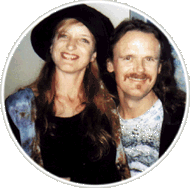
Fit of Passion is a collaborative poetry and music project my partner, Kim, and I undertook in 1997-98. Previous to it, I had been writing, performing and publishing my writing in a number of genres for many years; I also had a background in singing, and community arts, and an aspiration to write novels. My partner was an aspiring novelist, who had had some small successes with publishing short stories. He also had an extensive background as a musician, technician, and singer-songwriter. On a poetry reading tour of the United States in 1994, we realised that we both had a body of work in the performance poetry genre that, juxtaposed, possessed a weird symmetry, and we subsequently decided to put these poems and songs together to create a show about gender.
Like most poets, only a small percentage of my written work is particularly suited to oral presentation, and of these most of the poems were quite strident or otherwise emotional. They did seem to work in a live situation. Overall, the theme seemed to be ‘woman banging up against the brick walls of a sexist world’. Most of them dated from my twenties and thirties. Kim’s poetry dealt with aspects of being a man in society, as well as reflections on the weirdness of modern life. His performance-oriented work is far more whimsical and wordy than mine, and relies much more heavily on rhyme and conversational idioms. Mine is more in a free verse tradition, and at times pushes the boundaries of structural ‘correctness’ in order to achieve some approximation of an emotional state. Six original songs, written mostly by Kim, and performed together with guitar and vocal harmonies rounded out the performance set.
Most, but not all, of the work in Fit of Passion is in the ‘performance poetry’ genre, which makes it suitable for touring in places where poets would perhaps not normally be heard, and to audiences unaccustomed to oral poetry – very much an audience-building exercise. We received a grant from Arts Queensland to tour a show of this material in the regions, and also to publish the book and produce a cassette recording of the songs and some of the poems. We took some risks with the product, choosing some ‘difficult’ poems over more ‘entertaining’ ones, because we both strongly felt that the poetry was the most important thing and, for the purposes of this project, we both identified as writers more than as performers or ‘actors’.
The poems are largely about gender, and issues raised by ‘maleness’ and ‘femaleness’. I remember in the 1980s, as a young poet trying to get a hearing on a rather male-dominated scene in the Victorian city of Melbourne (Australia), I was often pilloried for being a ‘man-hating feminist’ because of pieces like the ‘Bitchpoem’, and it was something of a revelation when I teamed this work up with Kim’s. I believe that men also are oppressed by society’s expectations, though in different ways – work, fatherhood, what he calls ‘breadwinner prison’ and participation in war – but it is up to men to confront these issues, not something women need to ‘fix’ for them and, as a feminist, I totally support men voicing these concerns in their art. By putting the male and female voices together, we found that men who were challenged and/or threatened by my work no longer felt the need to confront me; instead, they could speak to Kim about the issues discussed in his work, leaving me free to talk to the women about the issues I had raised, without having to defend myself. Kim’s work provided something for the men to relate to, instead of simply reacting to the female issues I was discussing in my work.
We’ve both been continually amused and bemused by the responses this body of work has garnered from critics. Some feminist reviewers have absolutely loved my stuff, and hated Kim’s with vehemence. (‘How dare he say he won’t change the nappies of other people’s children!’ ‘How dare he say that white men are oppressed by the roles society has forced on them?’) Some male reviewers have attacked my work equally vehemently, sometimes just for the titles (‘Fancy writing a poem called ‘the raped woman’!) while extolling the virtues of Kim’s work because it supports their (male) world view. He’s been called a fascist and a genius; I’ve been called a bitch and an inspiration; the knowledge that we are a couple gets people totally confused as they just can’t see how we could possibly get on with each other. All of this just reinforces my opinion that there are cultural fascists everywhere, even in supposedly ‘politically correct circles’. We are both writing from a perspective of personal experience, so my retort to vehement critics at readings has always been, ‘If you don’t like my poem, then go home and write your own!’
That the poems are at times ‘edgy’ is a strength in terms of dealing with mainstream (ie. non- ‘literary’ audiences). Of the poems accompanying this article, I will deal first with Kim’s work. Some mainstream reviewers have been highly critical of pieces such as “My University Education” because of its sing-song form, not realising that this form was deliberately chosen in an effort to satirise the prevailing Australian worship of the “bush poem”out in the regions, and on the folk festival circuit, as exemplified by Banjo Patterson (eg.”The Man From Snowy River”). This type of poem has parallels in the American “Cowboy Poet” tradition, but the “rules” in Australia appear to be far more rigid, demanding strict rhyming and rhythmic structures, and a strong emphasis on “story” and the outback lifestyle. A deep anti-intellectualism often pervades bush poetry gatherings, and it’s not unusual for contemporary poets to be ignored in this context, or told that what they’re writing “isn’t poetry because it doesn’t rhyme”. Conversely, critics who are more used to contemporary free verse criticise the work because it resembles a bush poem, a form they regard as inferior doggerel, and “not real poetry”.
In “Epitaph for Barbie”, Kim takes on the prevailing social attitudes towards the female body that create unreal expectations and lifelong dissatisfaction for young women, suggesting, in its hysterical finale, that we should “Kill Barbie!” In “The Love We Recognise”, he uses the villanelle form to show how domestic violence is a cyclical process that spans generations. These are poems of solidarity with women’s struggle in a patriarchal world – if anyone wants to know why a feminist such as myself would team up with a writer like Kim, they need look no further. But in “Nappy Battles”, Kim really takes a risk, detailing the annoyance he feels when friends in the “alternative” communities we have lived in demand that he change the nappies (diapers) of other people’s children. He points out that the personal choice not to reproduce also means a choice not to take up these responsibilities. One feminist reviewer, who at the time of reviewing Fit of Passion had recently given birth, was absolutely incensed by this poem and scathing in her condemnation of him as a politically incorrect masculist. Certainly, for Kim, showing solidarity with feminists appears to be a thankless role.
My own work in this collection deals with issues that affect women, such as plastic surgery, (“my sister has a new set of breasts”); body image and teenage insecurity (“on acquiring a byron bay suntan”); and the myth of penis envy (“penis envy, sibling style”). The piece-de-resistance is the “Bitchpoem”, which never fails to raise a laugh from both genders as men hear their worst selves and women identify with the words. The poem is an attempt to say that women will always be called ‘bitches” if they don’t conform to male expectations, and suggests that women should reclaim the label and take it as a compliment. To blatantly bandy about words such as “bitch” and “penis” in a public forum is always an interesting exercise as such words often produce strong reactions, and their female user is often branded uncouth or “sluttish”. But after a lifetime of being branded a “bitch” and being told that possession of a penis makes one superior to those without one, I reserve my right to comment as I see fit.
Outside the literary scene, out in the ‘real world’, responses to Fit of Passion have been overwhelmingly positive. We’re still selling books, still performing the work on occasion, and have achieved sales and reviews that are pretty respectable when compared with commercially produced volumes. We’ll probably do a reprint next year – and, hopefully, put the cassette onto CD – so it’s still ‘current’. We also intend to do another Fit of Passion collection in the future though, so far, funding support has not been forthcoming.
The truth is that as poets we are practitioners of a marginalised art form, one that publishers and bookstores don’t, as a rule, see as financially viable to either publish or promote. This is despite a burgeoning readings scene (that in many cases has spilled over into a self-defining performance idiom), and the rise of ‘spoken word’, rap, and popular songs with a large ‘poetic’ component. These have taken off in youth culture, but many poets who write for the quiet contemplative experience of the printed page have felt left behind. Certainly one can’t demand of writers that they be equally as adept at performing, but some skill in this area is definitely an advantage when it comes to marketing one’s work.
We’ve lost count of the number of people who have stumbled across a Fit of Passion performance and stayed afterwards to talk about how they’d never realised that poetry could be interesting, challenging, or contemporary. If we’ve managed to convince anyone out in the general community that poetry is a living idiom that responds to the modern world, and is not just about birds and daffodils, then we feel we have fulfilled our purpose. Hopefully these audience members will be inspired to seek out more poetry on the strength of this experience.
Since the Fit of Passion publication and touring programme, both Kim and I have resumed our other writing. In 2000 I published a book of poetry for the page, and Kim published his first novel. I have recently submitted my thesis for a Master’s Degree in Creative Writing, and have been writing articles on conservation, health issues, and contemporary literary history. However, in our local litearary neighbourhood, we find ourselves continually being described (often perjoratively) as “performance poets”, as though the ability to present some of our writing in a performance idiom somehow precludes excellence or ability in other fields of writing. We have found it necessary to draw back from performing in order to be taken seriously as writers. No doubt we will eventually produce and tour a sequel to the first project, but at this stage such a course seems self-defeating. The arts community and the funding bodies seem unable to accept that a poet can also be a novelist, or that a singer or musician can also write criticism and factual articles. This morbid aversion to “genre-swapping” seems bizarre to us. We believe that a writer should be free to use whatever form or genre is appropriate to their material, without running the risk of being marginalised because they don’t fit neatly into a particular genre box.
A selection from Fit of Passion
my sister has a new set of breasts
by Liz Hall-Downs
my sister has a new set of breasts
perky and pert like an adolescent’s
two children, a full-time job, an exhausted
expression and a house-husband.
but she can attest to her success
by two new three thousand dollar breasts.
my sister has a new slim waist
though she was loved the way she was
slice scar below ribs, four stomach staples
anaesthetised, nearly died on the table
of the surgeon who said this would make her
a new slim waist to compensate for babies.
a new slim waist to compensate for babies.
my sister has two lovely new legs,
suctioned the cellulite, waxed all the hair
paid two thousand dollars to deny the rubenesque
contours of her womanliness. she’s saving now,
her thin pay cheque, for collagen
injections to her upper lip.
my sister is a fashion plate. she buys the
designers create. notes from the bank screw up her.
she works to pay for the latest dress she’ll
wear once or twice, the shoes that match to make
it nice. and she can neither sit nor stand
in clothes made only for looking at.
my sister has no feeling in her breasts.
my sister lives on packet soup and biscuits
my sister’s scar tissue hinders her movement
now she drives the block to the supermarket.
my sister’s gone bankrupt. she lost her job
they said she didn’t move fast enough.
my maturing sisters hate themselves
for not being society’s version of beauty
my beautiful sisters hurt themselves,
believe self-mutilation will make them happy
my smart, sad sisters have never believed
there is much more to love than a perfect body.
My University Education
by Kim Downs
When I went to university I had a simple plan.
I’d study things that helped me understand my fellow man.
I’d start with anthropology, psychology, sociology,
I’d learn his ideology and I’d come to shake his hand.
Now … sociology was Kinsey, criminology, pathology,
and when all was said and done it was full of other “ologies.”
But anyway, I figured, I should really focus on the individual
because everyone is different, despite “society” and “class.”
So … I shifted to psychology,
with Pavlov, Rorscharch, Skinner, Sigmund,
rats in mazes, monkeys in cages
electric probes barbarically implanted in their skulls.
But it came to me one day that this psychology could be … reduced.
For, after all, it’s mostly biological, in truth.
So, I turned my sights to biology (I was still stuck on “ologies”)
and bearing in mind my original goal, I went straight for old neurology.
I studied the hypothalamus and the neural pathway,
the cerebral cortex, right brain, left brain, and messenger RNA!
But wait a minute, man. I think I’m losing my “ology.”
This ain’t really biological. It’s kinda like … well … chemical.
So, down I swam ever deeper to find the very essence of man.
With my trusty sword called “chemistry” I’d make my final stand.
The periodic table was a loaded magnum in my hand.
Potassium’s-under-sodium’s-under-lithium’s-under-hydrogen’s-under-
valence-under-valium-undervalued condiminium …
I could see where this was leading. I could see where this was leading.
I could see where this was leading me … to physics!
Now, from Adam to the atom I have fondled the resistance
Now I’m down to the atom, “Yes, thankyou kindly madam,
I’ll have another glass of champagne.”
I have finally reached the bottom.
I am down to the essence of man.
So … I studied the atom, the “building block of matter,”
the solid little bastard on which the whole world is built.
But no sooner had I started than all my hopes were shattered;
because when you study the atom – credibility begins to wilt.
They tell us: If you take a single atom and you blow it right up
– Say, twenty miles across – like some giant coffee cup,
Directly in the centre you will find … a tennis ball.
This is your matter. And that is all!
Electrons whizz around it at six hundred miles per second
and are two thousand times smaller than the tennis ball, itself!
These little “whiffs of nothingness” are twenty miles away.
Creating the illusion of solidness, they say.
And even this tennis ball’s a little bit sus.
It’s made up of protons and neutrons and stuff,
all racing about inside their little fuzzy green shell
at forty thousand miles per second! Yeah right! Do tell!
And then there’s quarks and neutrinos and where does it end?
Isn’t anything solid? How does anything bend?
How does anything manage to sit, stand, or squat
when matter’s just … energy.
Wait a minute! Matter is what!
Small clumps of energy? Bumping about?
Waltzing and slam-dancing … “Ah bullshit!!” I shout.
Look, I’ve come a long way and I’m spinning out a bit.
I started out studying man but I ain’t learning shit!
And just when I think that I’ve finally reached home,
physics comes up to a wall of its own.
With one little door, and a sign … Oh dismay!
It says “This way to Philosophy 101-A”
No! No! No! That way leads to madness,
alcohol, hippies, mushrooms and sadness.
I’m studying man, but … where did he go?
He’s nothing but energy with a curious glow!
That’s it! Alright! I’ve had enough. I submit my resignation.
Next time I’ll try the school of life, maybe transubstantiation.
Ponder this, you who stand in line for next year’s registration.
Never let university get in the way of your education.
penis envy, sibling style
by Liz Hall-Downs
my four brothers are the subject of a family mythology
he eldest is the smallest
– they move up in gradations
i’m talking about penis size
that locker-room lie
the youngest wins by inches
though I felt no surprise at childhood bathtimes
we were different, but equal
till we ventured into life.
now he says he’s waiting for a family christmas
where he can tackle
– full-frontal –
this story that has made him a legend in our family.
a tiger, or a brown, perhaps
but, more likely, a benign carpet variety
pink and friendly.
he says he’d like to ‘pull it out
and whack it on their table’
to shock them from their myth-making
talk of his anatomy.
I laugh with him
– I love the way he takes it in his stride
and he smiles at my suggestion that the lifestyle
of our eldest
– the money prestige
video screens
expensive wines
and mistresses
must really be expressions of what
our family therapist said:
compensations of the first in line
for such a tiny dick size!
me, i’ve never wanted one
– old freud was wrong –
those dangling, strange appendages
did not a jealous sister make
and I have never found a use
for slide rules in the bedroom …
that gives our sex sustenance.
I feed on his calm humility,
the power his loves nurtures in me,
the essential physicality,
raw and primal,
signifying everything.
The Love We Recognize
by Kim Downs
Jane’s father used to drink and bash up his wife.
Jane’s mother forgave him again and again.
She thought love was like that. She didn’t know better.
She told Jane her father just had a bad temper.
She shouldn’t provoke him. It was mostly her fault.
Jane’s father used to drink and bash up his wife.
Jane watched this happen two hundred times
Before she reached puberty; and then … and later.
She thought love was like that. She didn’t know better.
At eighteen, Jane started to take her first lovers.
She chose ones with tempers. They seemed so familiar.
Jane’s father used to drink and bash up his wife.
Jane married Bill, a motor mechanic.
She fell pregnant. Had a daughter. Then another. Then a son.
She thought love was like that. She didn’t know better.
When Bill would get drunk … then angry … then hit her,
Jane forgave him. Like her mother. Like her daughters. Because:
Jane’s father used to drink and bash up his wife.
She thought love was like that. She didn’t know better.
on acquiring a byron bay suntan
by Liz Hall-Downs
me be all australian beachgirl
for a day – sometime in summer …
me be reborn teenager
me be victorian sunlover, starved of warmth
me be pictures in magazine – bondi beach or far
north queensland
me be memories, gidget, frankie avalon movies
me be waterskis, boats, oxygen chambers
me be swim with the fishies, hang with the surfies
me be homegrown lettuces, grown in the hippy hills
hydroponically
me be silly and stoned, loud music and bonfires
me be night in a forest of ideas
me be birds, feathers
me be brown as a berry, thin as a sapling,
cliched as an old saying
me be ‘anyway, what profits it
– in these too-late days –
there’s no ozone, it’s a dead
culture, still, me be dreaming …
me be fat teenager
me be shy in the highschool cafeteria
me be an other me. me I can hardly see
me be standing in the freezing
wind at bell’s beach
curled in rags and jumpers
in the backs of station wagons
me be uptight in bikini
me be best girlfriend of pretty girls
me be never quite
thin, or brown enough
me be all grown up but still small
me be byron bay on a summer’s day
me be rainforest, ocean, ash, dust
me be decaying body, cynical mind, still
open-hearted to love’s lies
me waiting for time, the gravity-pull
to make me air, to make me free
me be free as that eagle, riding the thermals
higher than high
me be wind
me be sky
Epitaph for Barbie
by Kim Downs
Up against the wall Matell Doll and spread ’em!
We’re gonna make you pay big-time, Momma.
You and your one billion sisters.
Purveyor of sordid stereotypes!
Exploiter of little girl’s expectations!
We can’t take you with a grain of salt, Barbie,
we need the whole shaker.
Yeah, yeah, we know your history:
astronaut, presidential candidate, UNICEF ambassador, rock star!
But deep down, Barbie,
you’re just a vacuous clothes horse,
with your big Barbie-boobs
and nothin between your legs.
False advertisement Barbie!
You know, we never even saw you smile until 1977.
I’ve got a few questions:
Exactly what do you expect little girls to believe about you?
That they’ll all grow up to have 36-18-33 figures?
That perfect skin and eyes that never close,
will render them successful and all-seeing?
That designer clothes and flash sports cars bring enlightenment?
That Ken is waiting for them when they’re all grown up?
And anyway, what would they do with him if they found him,
with his blow-wave haircut and that bulbous ill-defined lump
that passes for a groin?
And, given your respective anatomies,
exactly what have you and Ken been up to all these years,
sharing waterbeds and steamy nights at the drive-in?
I heard you dumped Ken for GI-Joe ’cause his lump is bigger.
And what about those rumours of you and Gumby,
in a cheap motel?
Hollow-headed whore!
You’re so transparent, Barbie.
You think you’ve passed yourself off
as some kind of buccaneering visionary
but all I see are pathetic attempts to disguise your
corporate invasion of foreign countries with
Indian Barbies, Italian Barbies, Eskimo Barbies,
bloody … Barbies from Botswana!
Bogus bimbo! Brainless plastic bombshell!!
You can change your stripes, Barbie,
but you’ll always be a dumb dolly hung up on fashion and fast cars.
And now that you’re thirty-five
will you be endorsing wrinkle creams and liposuction?
Or will your market strategy embrace
new and ever bolder personas to titillate young teen-age girls? What’s next?
Barbie the Bisexual? S & M Barb?
Bangkok Barb who does odd things
with razor-blades and screwdrivers?
Not this time, Momma!
Your Barb bacchanal is over, babe.
Didn’t you know there’s a price on your head?
That’s right … a dollar a head.
Even as we speak, legions of little girls
are ripping the heads off battalions of Barbies
and posting them to us for the rebate.
Our ethnic cleansing of cliched icons has begun
and you’re numero uno on the list, Barbie,
so kiss your ass goodbye, bitch, and good riddance!
Off with her head, boys.
Kill Barbie!
Kill Barbie!
Kill Barbie!!!
Bitch Poem (or It’s Really Quite A Compliment)
by Liz Hall-Downs
For five years my brother forgot my name:
“Do the dishes, bitch.”
At seventeen I got straight A’s:
“Unmarriageable bitch.”
Equal rights in conversation?
“Loudmouthed bitch.”
Intellectual argument?
“Smart-assed bitch.”
Justifiable complaint?
“Troublemaking bitch.”
Embrace the spiritual?
“Irrational bitch.”
Cry when you’re sad?
“Over-emotional bitch.”
Confront the past with therapy?
“Neurotic bitch.”
Admit ignorance?
“Stupid bitch.”
Say it’s unfair?
“Complaining bitch.”
Don’t want ‘looking after’?
“Ungrateful bitch.”
A poem about a sleazebag?
“Man-hating bitch.”
Pissed off at injustice?
“Aggressive bitch.”
Get your hands off my breast:
“Frigid bitch.”
Sexual feelings?
“Bitch on heat.”
Stand up to backstabber?
“Nasty bitch.”
Political power?
“Unfeminine bitch.”
‘Tired of voluntary work?
“Selfish bitch.”
Work hard for advancement?
“Competitive bitch.”
Put on weight?
“Fat bitch.”
Say no at the nightclub?
“Stuck-up bitch.”
Don’t dress like a lady?
Ugly bitch.”
Prefer the company of women?
“Lesbian bitch.”
Write about women’s lives?
“Feminist bitch.”
My favourite coffee cup?
“Life’s a bitch
and so
am I.”
Nappy Battles
by Kim Downs
I announce a fact – with pride – that never fails to make me happy.
I’m forty-three years old and I have never changed a nappy.
This simple fact, when stated socially amongst my finest peers.
Consistently arouses total outrage; a collective burning about the ears.
I’ve witnessed otherwise sane mothers go red and apoplectic
when I’ve dared to broach the subject of the nappy dialectic.
They are outraged. They are scornful. They plot in combinations
to entrap me in nefarious nappy-changing situations.
They thrust their reeking babies at me and demand that I must change them.
They insist I have my values skewed and I must rearrange them.
Into what? A creed that values soggy towels, pissed upon and crappy?
Just because their sordid lives resemble one large soiled nappy
doesn’t mean I have to follow suit. I’ve got better things to do
Than to spend my life immersed in loathsome baby pee and poo.
I chose not to have the bloody little stinkpots. And I’m glad!
I think its the most inspired decision I’ve probably ever had.
If I never change a single diaper I’ll die a happy chappy.
You can even make my epitaph: “The bastard never changed a nappy!”
So stuff your jealous plottings Mums and take it on the chin.
Stop trying to force my hand because you’re never going to win.
Long before I reached adulthood I had a striking vision
(It happened in a noisy classroom during long division)
I saw teeming hordes of toddlers waddling forth as one.
A sea of munchkin dictators. Tiny Atilla the Huns.
Their war-cry? A solemn warning to all adults. (Largely squandered.)
A chilling caution on the wind: “We came. We shat. We conquered.”
