Robert Friend’s poetry in this issue
_______
Gabriel Levin’s Essay on Robert Friend’s work
_______
Edward Field’s Essay on Robert Friend
_______
For all photos of Robert Friend: Courtesy of Jean Shapiro Cantu
Robert Friend’s translations and poetry.
Copyright © Jean Shapiro Cantu
[email protected]
_______
_______
“Obituary: Robert Friend” by Anthony Rudolf Originally published in The Independent (January 22, 1998); reprinted by permission of The Independent and Anthony Rudolf.
“Obituary: Robert Friend”
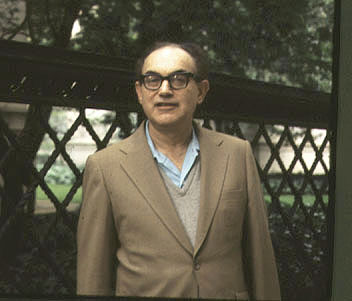
by Anthony Rudolf
The
Independent, January 22, 1998
Robert
Friend, poet and translator: born New York 25 November 1913;
died Jerusalem 12 January 1998.
Robert Friend
was an outstanding translator of modern Hebrew poets. His
active Hebrew was serviceable but not brilliant, but his passive Hebrew was
good enough to work in tandem with brilliant Hebrew scholars like Shimon
Sandbank (whose own translation of Chaucer has become a surprise bestseller in
Israel) on translations of books by the two major women poets of Israel and the
Yishuv (pre-state Palestine), Leah Goldberg and Ra’hel, as well as books by
Natan Alterman, Gabriel Preil and the Nobel prizewinner S.J. Agnon.
There were many translations of other
poets published in periodicals, and from Yiddish and other languages as well as
Hebrew. It is notable that this proud gay poet’s major work as a translator was
of women. Love poets, and often unhappy (to put it mildly), they spoke to the
very depths of Robert Friend. It may be that even the most gendered poetry is
finally androgynous.
Like many distinguished poetry
translators in a golden age of translation (Michael Hamburger, Jonathan
Griffin, Keith Bosley and Dan Weissbort are English examples), Friend endured
the relative neglect of his own poetry. His first book, Shadow on the Sun, was published as long ago as 1941. This was
followed by six books from small presses, including that of the legendary
Tambimuttu in London, and two from the Menard Press, most recently a “new
and selected poems,” The Next Room
(1995).
Modern Israel, for reasons that
everyone knows, houses Jewish immigrants from many lands. While Claude Vigée
was and is the only significant poet writing there in French, Friend was the
doyen but only one of many fine English-language (known as Anglo-Saxon even if
they are Lithuanian Jews from South Africa) poets in Jerusalem, including
Shirley Kaufman, Dennis Silk and Gabriel Levin.
Robert Friend was born into a family
of poor Jewish immigrants in a Brownsville slum in New York shortly before the
First World War. His mother, abandoned by her husband, often could not feed the
children. After graduating from Brooklyn College in 1934 during the great
depression, he sought work abroad.
He spent seven years in Puerto Rico
and Panama where he worked as a payroll typist, as an inspector of fire-extinguishers (a skill which came in useful later when
ferreting out weaknesses in his friends’ unpublished poems and translations),
as a censor during the Second World War (a skill ditto), and principally as an
English teacher. The typing and the deep knowledge and love of English and
American literature also came in more than useful in the years of his maturity,
when the poems and poetry translations began to flower.
Friend settled in Israel in 1950 and
taught English and American literature at the Hebrew University in Jerusalem
for more than 30 years. He was an authority on the work of E.M. Forster, though
his thesis on Forster was never published. But his heart and mind were planted
in poetry, in particular the poets whose formal skills in traditional metre and
rhyme had such an influence on him. Frost and Auden were his masters.
He was a very generous, affectionate
and supportive friend, though he had a stubborn, even mildly authoritarian streak,
and could be very touchy. But not only his friends and lovers and Aunt Yetta
loved him. Cats did too, as the many foreign and local visitors to his basement
flat on Jabotinsky Street (which had once housed a Naafi canteen and Martin
Buber’s library) could not fail to realise. Children too: I remember him in
London, entertaining my own children when they were young, with stories and
games and gestures. He was a born educator, a natural teacher.
Essentially a cultural Zionist in the
tradition of Ahad Ha’am, he had no time at all for the territorialists and
fundamentalists on the Right whose obsessions threaten to undo the work of
Rabin and Peres, work which was made possible by the earlier arguments and
commitment of the liberal left – to which he belonged. He put his ideals into
practice by loving men across the border line. Few
Israelis, even Sabras, had his understanding of the Palestinians.
The best comment on his poetry was by
the friend who saw him as a father and his poetry as “the mother ground I
started from” – the distinguished and far better-known New York poet
Edward Field: “In Robert Friend’s work I respond to a teaching that is beyond
the individual poem but is implicit in all of it as a devotion, not just to
craft, but to self-examination. His refusal to trust easily – feelings,
language, or ideas – is almost religious, and is the basis of the humour in
many of his poems. Since there is no question of denying the erotic, the poems
celebrate it, all the while exploring the bitter, exacting price. But the
poetics are so playful and musical that we are charmed from
any possible dismay, to recognise that these poems are truly about ourselves.”